Quick Answer
Integrated Fountain Lightss are engineered LED lighting systems that combine illumination, waterproof protection, structural durability, and intelligent control into a single compact unit. Compared with traditional fountain lighting, integrated designs simplify installation, improve underwater reliability, reduce maintenance costs, and deliver more consistent lighting performance. As commercial landscapes, municipal projects, hotels, and entertainment venues demand smarter water features, integrated fountain lighting has become the preferred solution for modern fountain engineering.
Key Takeaways
· Integrated Fountain Lightss improve both the visual performance and operational efficiency of water features.
· Integrated LED designs reduce cable complexity and improve long-term waterproof reliability.
· High-quality systems typically feature IP68 waterproof protection, 316 stainless steel housings, and RGBW LED technology.
· Intelligent control systems such as DMX512 allow synchronized lighting effects with pumps, music, and water movement.
· Proper material selection and installation have a greater impact on service life than lamp brightness alone.
Table of Contents
· Why Fountain Lighting Matters More Than Most People Think
· What Are Integrated Fountain Lightss?
· How Integrated Fountain Lights Work
· Why More Projects Are Moving Toward Integrated Designs
· Core Technologies Behind Modern Fountain Lighting
· Material Selection and Waterproof Engineering
· Control Systems and Intelligent Lighting
· Installation and Maintenance Considerations
· Industry Case Study
· Frequently Asked Questions
· Final Thoughts
A Beautiful Fountain Can Still Look Ordinary
Visit a public plaza during the day.
The water looks lively.
The nozzles perform exactly as designed.
Everything appears impressive.
Come back after sunset.
Sometimes the same fountain feels... surprisingly flat.
The pumps haven't changed.
The water choreography hasn't changed.
What changed is the lighting.
Experienced fountain designers understand something that newcomers often overlook.
People rarely remember a fountain because of its pumps.
They remember how it looked at night.
That's why lighting has gradually moved from being an accessory to becoming part of the engineering itself.
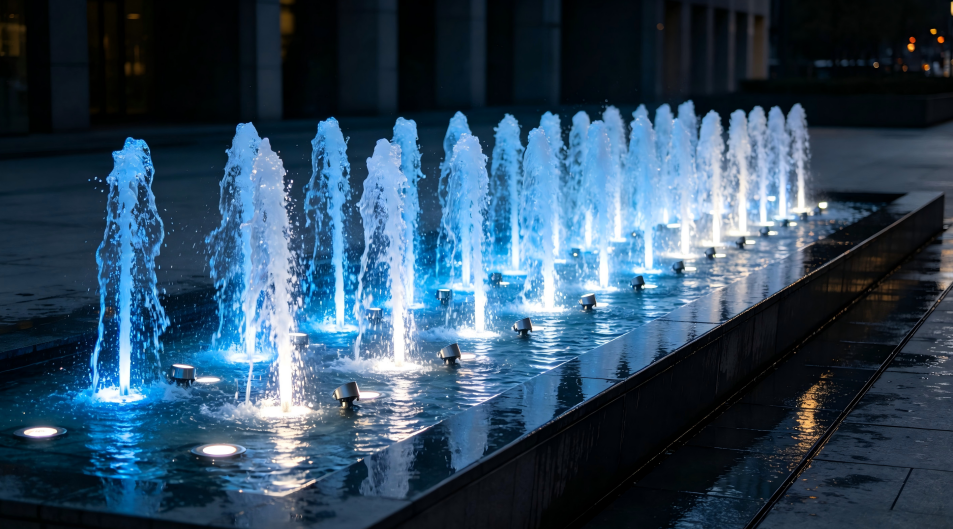
Modern Integrated Fountain Lightss don't simply illuminate water.
They shape how people experience the entire project.
For landscape architects, municipal engineers, and fountain contractors, lighting has become one of the biggest factors affecting visual quality, maintenance costs, and long-term reliability.
What Are Integrated Fountain Lightss?
An Integrated Fountain Lights system is an underwater LED lighting fixture designed specifically for fountains and water features.
Unlike older lighting systems that relied on separate waterproof housings, external drivers, and multiple connection points, integrated designs combine essential components into one sealed unit.
Typically, an integrated fixture includes:
· High-efficiency LED modules
· Waterproof driver
· Optical lens
· Stainless steel housing
· Waterproof cable connection
· Heat dissipation structure
· Mounting system
Everything works together as one engineered product.
That may sound like a small improvement.
In practice, it changes almost every aspect of fountain installation and maintenance.
Why Integration Matters
Every electrical connection placed underwater introduces potential risk.
More connectors generally mean:
· More installation time
· More sealing work
· More maintenance points
· Greater failure probability
Integrated systems eliminate much of that complexity.
Fewer components.
Fewer joints.
Fewer opportunities for water intrusion.
That's one reason LED integrated fountain lights have become the preferred choice for commercial water feature projects.
How Integrated Fountain Lights Improve Water Feature Performance
People often assume fountain lighting serves only one purpose.
Making the water visible.
Actually, modern lighting performs several engineering functions simultaneously.
It Creates Better Water Definition
Water itself is transparent.
Without proper lighting, many fountain effects disappear after dark.
Integrated lighting helps define:
· Water columns
· Spray patterns
· Mist effects
· Cascades
· Water curtains
· Dancing fountains
Proper beam angles allow designers to highlight the shape of the water rather than simply making it brighter.
Good fountain lighting reveals movement.
Great fountain lighting creates depth.
It Improves Project Reliability
Ask contractors what causes many service calls.
The answer usually isn't LED failure.
It's water ingress.
Electrical connections.
Poor sealing.
Cable damage.
Integrated designs reduce these risks by minimizing exposed components and sealing sensitive electronics inside factory-tested housings.
This significantly improves long-term reliability in demanding underwater environments.
It Supports Smarter Fountain Control
Today's commercial fountains rarely operate with simple ON/OFF lighting.
Most projects require dynamic lighting sequences synchronized with:
· Water pumps
· Music
· Laser systems
· Mist generators
· Multimedia shows
Modern DMX fountain lighting systems make this possible.
DMX512 is a digital communication protocol originally developed for stage lighting.
Today, it has become one of the most widely adopted control standards for architectural and fountain lighting because it allows hundreds of fixtures to operate with precise timing.
Instead of treating each light as an individual fixture, designers can create complete lighting scenes that change color, brightness, and timing automatically.
The Shift Toward LED Technology
Traditional halogen fountain lights consumed large amounts of electricity while generating significant heat.
Maintenance was also frequent.
LED technology changed that equation.
According to the U.S. Department of Energy, modern LED lighting typically consumes substantially less electricity than traditional lighting technologies while offering significantly longer operational lifespans when properly designed and managed.
For fountain projects operating every evening, these improvements quickly become meaningful.
Lower energy consumption reduces operating costs.
Longer service life reduces maintenance interruptions.
And better optical control produces more consistent lighting effects.
Material Selection Makes a Bigger Difference Than Many Buyers Expect
From a distance, many fountain lights look almost identical.
Inside, however, the differences can be considerable.
Professional underwater fountain lights are designed to withstand conditions that ordinary outdoor lighting rarely encounters:
· Continuous water immersion
· Mineral deposits
· Chlorinated water
· Temperature fluctuations
· Mechanical vibration
· UV exposure
· Chemical corrosion
The housing material becomes critically important.
Why Stainless Steel Remains the Industry Standard
Most premium stainless steel fountain lights are manufactured using either:
· 304 stainless steel
· 316 stainless steel
Both offer good corrosion resistance.
However, 316 stainless steel contains molybdenum, which significantly improves resistance to chlorides and aggressive water environments.
This makes it particularly suitable for:
· Coastal installations
· Saltwater features
· Commercial fountains
· High-end landscape projects
Although the initial material cost is higher, it often results in longer service life and lower maintenance costs over the life of the project.
Waterproof Performance Is More Than an IP Rating
Many buyers immediately ask:
"Is it IP68?"
That's an important question.
But not the only one.
An IP68 fountain light indicates protection against dust ingress and continuous immersion under specified conditions according to IEC 60529.
Still, waterproof reliability depends on much more than certification.
Experienced manufacturers also pay close attention to:
· Seal material quality
· Cable gland design
· Housing machining precision
· Lens bonding process
· Pressure testing
· Thermal expansion management
A fixture can achieve IP68 in laboratory testing.
Maintaining that performance after years underwater is the real challenge.
Color Quality Has Become Part of Fountain Design
White lighting still has its place.
Especially for classical architectural fountains.
But modern projects increasingly favor programmable color systems.
RGBW fountain lights combine:
· Red LEDs
· Green LEDs
· Blue LEDs
· Dedicated White LEDs
The addition of a separate white LED produces cleaner white light than relying solely on RGB color mixing.
This gives designers much greater flexibility.
Warm white for elegant hotel entrances.
Cool white for public plazas.
Dynamic colors for entertainment venues.
One lighting system can support all of them.
Experienced Designers Think Differently
After working on water feature projects for years, one pattern becomes obvious.
People often spend months discussing pump specifications.
Nozzle layouts.
Pipe sizing.
Control cabinets.
Lighting is sometimes left until the end.
Ironically, it's usually the lighting that visitors notice first.
A well-designed fountain deserves lighting engineered with the same level of attention.
Because when daylight disappears, lighting becomes the project.
Core Technologies That Define Modern Integrated Fountain Lights
If you've compared fountain lights from different suppliers, you've probably noticed something.
Many products look nearly identical in the catalog.
Similar housing.
Similar dimensions.
Even similar wattage.
Yet after a year or two in service, the performance gap becomes obvious. One lighting system still delivers crisp, even illumination, while another starts showing water ingress, uneven brightness, or premature LED failure.
The difference usually isn't marketing. It's engineering.
Optical Design: Lighting the Water, Not Just the Fixture
One common misconception is that higher wattage automatically creates a better fountain display.
It doesn't.
Water behaves differently from solid objects. Light is reflected, refracted, and scattered as it passes through moving water. Without a well-designed optical system, much of the light is simply wasted.
This is why professional LED integrated fountain lights place significant emphasis on optical engineering.
Instead of increasing power consumption, manufacturers optimize:
· Beam angle
· Lens design
· LED positioning
· Color consistency
· Light distribution
The result is a cleaner and more defined water effect with less energy.
Choosing the Right Beam Angle
Every fountain produces a different water pattern.
A narrow jet requires a different lighting approach than a wide waterfall or mist curtain.
Typical beam angles include:
Beam Angle | Best Application | Lighting Effect |
15°–30° | High vertical jets | Concentrated, long-distance illumination |
30°–45° | Medium fountain nozzles | Balanced brightness and coverage |
60°–90° | Waterfalls, cascades, pools | Wide and uniform lighting distribution |
120° | Decorative ponds and landscape water features | Soft ambient illumination |
Selecting the correct beam angle often produces a greater visual improvement than increasing LED power.
RGBW Technology Delivers More Natural Colors
Early fountain lighting relied on monochromatic lamps or basic RGB LEDs.
Today's commercial projects typically specify RGBW fountain lights.
The additional white LED may seem like a small upgrade.
Actually, it changes the entire lighting experience.
Instead of mixing red, green, and blue to imitate white light, RGBW fixtures generate a dedicated white output with better color rendering and higher brightness.
This allows operators to switch seamlessly between:
· Elegant warm white for hotels
· Neutral white for civic plazas
· Cool white for contemporary architecture
· Dynamic color-changing scenes for entertainment fountains
One fixture supports multiple design objectives without compromising visual quality.
Intelligent Control Makes Water and Light Work Together
Modern fountains are no longer static installations.
Visitors expect movement.
Color transitions.
Music synchronization.
Interactive displays.
That level of coordination depends on the lighting control system.
For most commercial projects, DMX512 remains the industry standard.
Originally developed by the United States Institute for Theatre Technology (USITT), DMX512 is now widely used in architectural and landscape lighting because it provides reliable communication between controllers and lighting fixtures.
With a properly designed DMX fountain lighting system, operators can control:
· Individual fixtures
· Lighting groups
· Brightness levels
· Color transitions
· Timing sequences
· Dynamic lighting effects
The result is a synchronized water feature rather than a collection of independent lights.
Thermal Management Often Determines LED Lifespan
LEDs are highly efficient.
That doesn't mean they don't generate heat.
Heat is still the biggest factor affecting LED lifespan.
This surprises many buyers because the fixtures operate underwater.
Surely the surrounding water keeps everything cool?
Not entirely.
Heat must first travel from the LED chip into the housing before the surrounding water can dissipate it.
Poor thermal design creates localized heat buildup inside the fixture.
Professional Integrated Fountain Lights address this through:
· High-conductivity aluminum heat sinks
· Optimized PCB design
· Precision thermal interfaces
· Efficient housing structures
· Intelligent driver management
Better heat dissipation helps maintain consistent brightness while extending component life.
Waterproof Engineering Goes Beyond IP68
Earlier we discussed IP68 ratings.
Now let's look at what happens behind the certification.
Reliable underwater lighting depends on several engineering details working together.
Housing Precision
Machining tolerances affect how well sealing surfaces fit together.
Even slight inconsistencies may compromise long-term waterproof performance.
Cable Entry System
Cable connections remain one of the most vulnerable areas in underwater fixtures.
Professional designs typically incorporate:
· Compression cable glands
· Multi-layer sealing
· Corrosion-resistant fittings
· Waterproof strain relief
These features reduce stress on electrical connections during years of operation.
Lens Bonding
The lens experiences continuous pressure changes caused by temperature variation and water movement.
High-quality bonding materials must remain stable despite:
· UV exposure
· Thermal cycling
· Chemical treatment
· Continuous immersion
This is one reason reputable manufacturers invest heavily in sealing technology rather than focusing solely on LED specifications.
Material Selection Affects More Than Appearance
Many buyers first notice the polished stainless steel finish.
It certainly looks attractive.
But appearance is only one benefit.
Material selection directly influences durability, corrosion resistance, and maintenance frequency.
Component | Recommended Material | Why It Matters |
Housing | 316 Stainless Steel | Superior corrosion resistance in harsh water environments |
Lens | Tempered Glass | High impact strength and excellent light transmission |
Seal | Silicone Rubber | Stable waterproof performance across wide temperature ranges |
Fasteners | Stainless Steel | Prevents rust and simplifies maintenance |
Cable Jacket | UV-Resistant Rubber | Protects against sunlight, moisture, and mechanical wear |
These materials are widely used in commercial underwater fountain lights because they balance durability with long-term performance.
Installation Quality Is Just as Important as Product Quality
Even the best fixture can fail if installed incorrectly.
After visiting numerous fountain projects over the years, one pattern stands out.
Many problems traced back to installation rather than manufacturing.
Common issues include:
· Incorrect cable routing
· Overtightened fittings
· Poor waterproof junction boxes
· Inadequate voltage planning
· Insufficient drainage around cable entries
Experienced contractors generally test the complete lighting system before filling the fountain.
That simple step often prevents expensive troubleshooting later.
Maintenance Doesn't Have to Be Complicated
Integrated designs are popular partly because they simplify routine maintenance.
Typical inspection schedules include:
Monthly
· Remove surface debris
· Check water clarity
· Inspect visible cable condition
Quarterly
· Clean the tempered glass lens
· Verify lighting synchronization
· Check fixture mounting stability
Annually
· Inspect waterproof seals
· Test insulation resistance
· Confirm DMX communication
· Review electrical connections
Preventive maintenance usually takes far less time—and costs much less—than repairing water-damaged fixtures.
Real Industry Case: The Dubai Fountain
One of the best-known examples of advanced fountain lighting is the Dubai Fountain, located at the base of the Burj Khalifa in the United Arab Emirates.
Designed by WET Design, the project integrates thousands of underwater lighting fixtures with sophisticated pump systems, variable-frequency drives, and synchronized control technology to create large-scale choreographed performances.
Although the exact lighting specifications have evolved over time and are proprietary, the project demonstrates several principles that now influence commercial fountain engineering worldwide:
· Precise synchronization between water movement and lighting
· Durable underwater lighting designed for continuous operation
· Intelligent digital control systems for complex lighting sequences
· Energy-efficient LED technology replacing earlier-generation light sources in many upgrades
The takeaway isn't that every project needs the same scale.
It's that reliable lighting begins with system integration rather than individual components.
Even a modest commercial fountain benefits from the same engineering philosophy.
A Practical Observation
I've seen project teams spend weeks comparing lumen output between different fixtures.
Five percent more brightness.
Ten percent less power consumption.
Those numbers matter.
But they rarely determine whether a fountain still looks impressive five years later.
What usually does?
Reliable waterproof construction.
Consistent optical performance.
Quality materials.
Thoughtful installation.
Those are the details visitors never notice directly—but they notice the results every evening
How to Choose the Right Integrated Fountain Lights Manufacturer
Selecting a lighting fixture is only half of the decision.
Selecting the manufacturer behind it is where long-term performance is really determined.
From the outside, many Integrated Fountain Lights appear almost identical. Product photos often show polished stainless steel housings, colorful RGB effects, and similar technical specifications.
But once those fixtures have spent two or three years underwater, the differences become obvious.
Some continue operating with stable brightness and reliable waterproof performance.
Others begin showing condensation, color inconsistency, driver failures, or water ingress.
That gap rarely comes down to luck. It usually reflects engineering capability, manufacturing quality, and quality control.
Look Beyond Wattage and Price
Many buyers naturally compare three specifications first:
· Wattage
· Lumens
· Unit price
They're important, but they don't tell the whole story.
When evaluating a supplier, it's worth asking questions like:
· Do they manufacture the fixtures themselves or outsource production?
· Can they customize beam angles and optical lenses?
· Are the waterproof tests performed on every production batch?
· Which LED brands and driver components are used?
· Can they provide photometric data or IES files?
· Are spare parts available five years later?
These answers reveal much more about a supplier than a quotation sheet.
Quality Control Should Cover Every Production Stage
Reliable Integrated Fountain Lights are built through process control, not final inspection alone.
Professional manufacturers typically inspect:
Raw Materials
Incoming materials should be verified before production begins.
This includes:
· Stainless steel grade
· LED bin consistency
· Optical lenses
· Silicone sealing materials
· Waterproof cables
Material consistency directly affects long-term product reliability.
Assembly Process
During production, technicians normally monitor:
· Waterproof sealing
· Driver installation
· Lens positioning
· Fastener torque
· Electrical insulation
· Cable gland installation
Small assembly variations can significantly influence underwater performance.
Finished Product Testing
Before shipment, quality manufacturers often perform:
Inspection Item | Purpose |
Waterproof Pressure Test | Verify sealing integrity |
Electrical Safety Test | Confirm insulation and grounding |
Aging Test | Identify early component failures |
DMX Communication Test | Ensure stable signal transmission |
Color Consistency Test | Match RGBW output across fixtures |
Visual Inspection | Detect cosmetic or assembly defects |
Power Consumption Test | Verify operating efficiency |
These inspections reduce the likelihood of failures after installation, where repairs are considerably more expensive.
Common Purchasing Mistakes
After working with contractors and project managers for many years, certain purchasing mistakes appear repeatedly.
Fortunately, they're also avoidable.
Focusing Only on Initial Cost
A lower purchase price may look attractive during bidding.
However, replacing underwater lighting after installation often involves:
· Draining the fountain
· Removing nozzles
· Accessing underwater cables
· Reinstalling fixtures
· Retesting the control system
Labor costs frequently exceed the savings from choosing the cheapest fixture.
Looking at the total cost of ownership (TCO) usually leads to better purchasing decisions.
Choosing the Wrong Material
Not every fountain operates in the same environment.
Freshwater decorative ponds.
Chlorinated hotel fountains.
Coastal public squares.
Saltwater installations.
Each places different demands on lighting equipment.
For aggressive environments, 316 stainless steel generally offers better corrosion resistance than 304 stainless steel, helping reduce long-term maintenance.
Ignoring the Control System
Some buyers concentrate on the fixtures themselves while overlooking compatibility with the lighting controller.
Before purchasing, verify compatibility with:
· DMX512 controllers
· PLC automation systems
· Music synchronization software
· Remote monitoring platforms
· Smart lighting control systems
Integration issues are much easier to solve before installation than afterward.
Overlooking Future Maintenance
Every lighting system eventually requires servicing.
When evaluating a manufacturer, ask:
· Can replacement drivers be supplied?
· Are spare lenses available?
· Will identical fixtures still be produced several years from now?
· Is technical documentation available?
Long-term support often proves just as valuable as product quality.
Industry Trends Shaping Integrated Fountain Lights in 2026
The fountain industry continues to evolve alongside broader developments in smart cities, sustainable construction, and digital infrastructure.
Several trends are becoming increasingly influential.
Smart Lighting Integration
More municipalities and commercial developments are connecting fountain lighting to centralized building management systems.
Remote monitoring allows operators to:
· Detect faults earlier
· Schedule lighting automatically
· Adjust brightness remotely
· Reduce maintenance visits
This improves operational efficiency while lowering maintenance costs.
Higher Energy Efficiency
According to the International Energy Agency (IEA), LED technology continues to improve in luminous efficacy while reducing electricity consumption across commercial lighting applications.
For fountains operating several hours every evening, these efficiency gains translate into measurable energy savings over the system's lifetime.
Sustainability Is Becoming Part of Procurement
Many project specifications now evaluate products based on more than purchase price.
Additional considerations include:
· Product lifespan
· Repairability
· Energy consumption
· Material durability
· Environmental compliance
Manufacturers offering CE, RoHS, and other internationally recognized certifications are often better positioned for commercial and government projects.
More Customized Fountain Lighting
Architects increasingly want lighting that complements the unique identity of each project rather than relying on standard products.
This drives demand for:
· Custom beam angles
· Adjustable mounting systems
· Special housing finishes
· Intelligent programming
· Tailored color temperatures
Customization is becoming a competitive advantage rather than an exception.
Frequently Asked Questions
Are Integrated Fountain Lights better than traditional underwater lights?
For most modern projects, yes.
Integrated designs reduce wiring complexity, improve waterproof reliability, simplify maintenance, and provide better compatibility with intelligent control systems.
What IP rating should commercial fountain lights have?
Commercial underwater lighting is generally specified with an IP68 rating in accordance with IEC 60529, ensuring protection against continuous water immersion under defined conditions.
Can Integrated Fountain Lights be synchronized with music?
Absolutely.
Most professional systems support DMX512, allowing synchronized control of lighting effects, pumps, and audio systems for dynamic fountain performances.
How long do LED Integrated Fountain Lights typically last?
Service life depends on component quality, thermal management, operating conditions, and maintenance.
High-quality commercial LED fixtures are commonly designed for 50,000 hours or more under appropriate operating conditions, although actual performance varies by application.
Final Thoughts
Modern fountains are no longer judged solely by the movement of water.
They're judged by the experience they create.
Lighting plays a central role in that experience.
Well-designed Integrated Fountain Lights do much more than illuminate water. They improve safety, simplify installation, reduce maintenance, support intelligent control systems, and help architects and engineers create memorable nighttime landscapes.
Choosing the right lighting solution isn't about selecting the brightest fixture or the lowest price. It's about understanding how optics, waterproof engineering, materials, thermal management, and control technology work together as a complete system.
Projects that take this broader view tend to deliver better visual performance, lower operating costs, and greater reliability over the years.