Quick Answer
Water Feature Devices are the engineered components that make modern fountains function safely, efficiently, and consistently. Rather than relying on a single piece of equipment, today's water features combine fountain nozzles, submersible fountain pumps, underwater LED fountain lights, water feature control systems, filtration equipment, and intelligent controllers into one integrated system. When these devices are properly selected and matched, they improve water performance, reduce maintenance, lower energy consumption, and create a more engaging visual experience.
Key Takeaways
· Water Feature Devices form the foundation of every modern fountain project, from decorative landscape fountains to large-scale musical water shows.
· A well-designed system balances hydraulics, lighting, electrical control, and water treatment—not just aesthetics.
· Choosing compatible equipment can significantly improve reliability and reduce long-term operating costs.
· Modern projects increasingly rely on smart fountain control systems, energy-efficient pumps, and programmable LED lighting.
· Successful fountain engineering is about system integration rather than individual products.
Table of Contents
· Why Fountain Design Has Changed
· What Are Water Feature Devices?
· How Water Feature Devices Work Together
· The Core Components of a Modern Fountain System
· Why System Integration Matters More Than Individual Equipment
· Material Selection and Engineering Standards
· Real-World Project Example
· Frequently Asked Questions
· Final Thoughts
A Beautiful Fountain Starts Long Before the Water Moves
People usually notice the water first.
A graceful jet reaching ten meters into the air.
A smooth curtain flowing over stone.
Lighting that changes color as music begins.
That's what visitors remember.
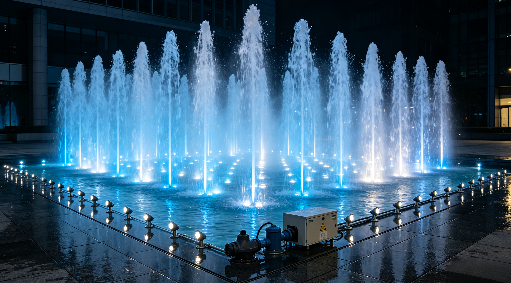
But behind every successful fountain is a collection of carefully selected Water Feature Devices working together with surprising precision.
Take away just one key component—a pump that's slightly undersized, a poorly designed nozzle, or a controller that struggles to synchronize lighting—and the entire experience changes.
I've seen projects where architects invested heavily in premium stone finishes and elegant landscape design, only to discover the fountain never quite performed as expected. The issue wasn't the design concept. It was the engineering underneath.
Modern fountain design isn't simply about moving water anymore.
It's about managing pressure, flow, lighting, automation, water quality, and long-term reliability as one coordinated system.
That's exactly why Water Feature Devices have become such an important topic for designers, contractors, and project owners.
What Are Water Feature Devices?
The term Water Feature Devices refers to the specialized mechanical, hydraulic, electrical, and electronic equipment that enables a water feature to operate safely and efficiently.
Rather than being a single product, it describes a complete ecosystem of components.
A typical commercial fountain may include:
· Submersible fountain pumps
· Fountain nozzles
· LED fountain lights
· DMX fountain control systems
· Water filtration equipment
· Water level sensors
· Solenoid valves
· Stainless steel pipe fittings
· Electrical control cabinets
· Variable frequency drives (VFDs)
· Waterproof cable systems
Each component performs a specific task.
The real magic happens when they operate together.
More Than Decorative Equipment
People sometimes assume fountains are mainly architectural features.
From an engineering perspective, they're hydraulic systems.
Water pressure must remain stable.
Flow rates need to match nozzle specifications.
Lighting has to synchronize with water movement.
Electrical equipment must remain protected despite continuous exposure to moisture.
All of those functions depend on properly selected water feature equipment.
That's why experienced fountain engineers rarely choose products individually.
They design complete systems.
Why Water Feature Devices Matter More Than Ever
Modern fountains have become far more sophisticated than they were twenty years ago.
Visitors expect movement.
Interaction.
Color.
Music.
Programmable shows.
Remote management.
Meeting those expectations requires equipment capable of much more than pumping water.
Today's commercial fountain equipment is expected to deliver:
· Consistent hydraulic performance
· Intelligent lighting control
· Energy efficiency
· Reliable waterproof operation
· Easy maintenance
· Long service life
These requirements have transformed the role of Water Feature Devices from supporting hardware into core engineering assets.
Every Device Affects Overall Performance
One lesson becomes obvious after working on fountain projects for a while.
No component works in isolation.
Increasing pump capacity without changing nozzle selection may create unstable water columns.
Installing brighter lights without adjusting beam angles may actually reduce visual quality.
Using premium nozzles with an outdated control system limits the fountain's creative potential.
Performance comes from balance.
Not individual specifications.
How Water Feature Devices Work Together
Think of a modern fountain as a living system rather than a collection of products.
Each device depends on the others.
Here's a simplified workflow.
Step 1: Water Circulation
A submersible fountain pump draws water from the basin and generates the pressure required for the fountain.
Pump selection influences:
· Jet height
· Flow stability
· Energy consumption
· Operating noise
Even a small mismatch between pump performance and nozzle design can noticeably affect the final display.
Step 2: Water Shaping
Next comes the nozzle.
This is where water begins taking its visible form.
Different fountain nozzles create different effects:
· Vertical jets
· Fan sprays
· Foam columns
· Bell shapes
· Water curtains
· Mist effects
Although nozzles often appear simple, they are carefully engineered hydraulic devices designed to control flow, pressure, and spray pattern.
Step 3: Lighting the Water
During daylight, water provides the visual impact.
At night, lighting becomes equally important.
Modern underwater fountain lights illuminate the water itself rather than simply brightening the surrounding area.
Today's projects increasingly use:
· RGBW lighting
· DMX-controlled lighting sequences
· Programmable color transitions
· Energy-efficient LED technology
Lighting transforms a functional fountain into a landmark.
Step 4: Intelligent Control
None of these components operate independently.
A modern water feature control system coordinates:
· Pump speed
· Valve timing
· Lighting effects
· Music synchronization
· Safety monitoring
· Scheduled operation
Digital control has fundamentally changed fountain engineering.
Instead of manually operating equipment, facility managers can automate entire performances using programmable controllers.
Modern Fountain Design Is Becoming Smarter
Several trends are reshaping the industry.
The first is automation.
Municipal projects increasingly require remote monitoring to reduce maintenance costs.
The second is sustainability.
According to the International Energy Agency (IEA), improvements in motor efficiency and LED technology continue to reduce electricity consumption across commercial infrastructure. Those same advances are influencing fountain systems, where efficient pumps and LED lighting help lower operating costs over the life of a project.
The third trend is user experience.
Visitors no longer expect static water displays.
Interactive fountains, synchronized music, and dynamic lighting have become common features in public spaces, hotels, shopping centers, and cultural attractions.
Meeting these expectations requires more capable Water Feature Devices than ever before.
Engineering Is About Coordination, Not Complexity
There's an interesting misconception in the fountain industry.
Some people believe adding more equipment automatically creates a better fountain.
Not necessarily.
In fact, many successful projects rely on relatively straightforward systems.
The difference lies in how well each component complements the others.
A properly matched pump, nozzle, lighting fixture, and controller often outperform a much larger system assembled without careful engineering.
That's one of those lessons experience teaches rather quickly.
You stop asking, "Which product is best?"
Instead, you start asking, "Which products work best together?"
The Core Categories of Water Feature Devices
Walk around any commercial fountain and most of the equipment is hidden from view.
That's intentional. Visitors should notice the water, not the machinery.
Behind the scenes, however, every successful fountain relies on a carefully engineered combination of Water Feature Devices. Each device performs a different task, but none of them work independently. Change one component, and the performance of the entire system can change with it.
Let's look at the equipment that truly drives a modern water feature.
Submersible Fountain Pumps: The Heart of the System
If the fountain has a heart, this is it.
A submersible fountain pump provides the hydraulic energy needed to move water through the entire system. Every spray pattern, cascade, or dancing jet begins with stable water pressure.
Choosing the correct pump isn't simply about selecting the highest flow rate.
Engineers normally evaluate several factors together:
· Total Dynamic Head (TDH)
· Required flow rate (GPM or m³/h)
· Pump efficiency
· Motor power
· Operating voltage
· Continuous-duty capability
· Energy consumption
An oversized pump wastes electricity and creates unstable water effects.
An undersized pump struggles to maintain pressure, especially when multiple nozzles operate simultaneously.
The best-performing fountains usually pair pumps and nozzles as one hydraulic system rather than selecting them separately.
Variable Frequency Drives Make Pumps Smarter
Modern commercial fountains increasingly incorporate Variable Frequency Drives (VFDs).
Instead of operating at one fixed speed, VFDs allow pumps to adjust output dynamically.
This offers several advantages:
· Lower electricity consumption during low-demand operation
· Smooth acceleration and deceleration
· Reduced mechanical wear
· Improved synchronization with music and lighting
· Better control over changing water patterns
For musical fountains, VFD technology has become almost standard practice.
Fountain Nozzles: Where Engineering Becomes Art
Many people think fountain nozzles are simple metal fittings.
Actually, they're precision hydraulic components.
A nozzle controls how water leaves the system.
Tiny adjustments in internal geometry can dramatically change:
· Jet height
· Spray angle
· Water texture
· Stability
· Wind resistance
This explains why professional fountain nozzles are manufactured with surprisingly tight machining tolerances.
Poorly designed nozzles often produce uneven spray patterns, excessive splashing, or unstable water columns.
Different Water Effects Require Different Nozzle Designs
Rather than choosing a nozzle based purely on appearance, engineers first define the desired hydraulic behavior.
Some common applications include:
· Vertical jet fountains
· Foam jet displays
· Bell fountains
· Fan sprays
· Water curtains
· Mist systems
· Laminar flow jets
Each design places different demands on pump pressure and water quality.
For example, laminar nozzles require exceptionally clean water and stable flow to maintain their crystal-clear arcs.
Underwater LED Fountain Lights
Water attracts attention during the day.
Lighting keeps that attention after sunset.
Modern underwater fountain lights have evolved well beyond simple illumination.
Today's systems combine optics, waterproof engineering, and intelligent control into compact fixtures capable of producing highly dynamic visual effects.
Commercial projects typically specify:
· RGBW LED technology
· IP68 waterproof protection
· Stainless steel housing
· DMX512 compatibility
· Long-life LED modules
These fixtures consume significantly less energy than older halogen lighting while providing greater flexibility in color programming and scene creation.
Lighting Is About More Than Brightness
A common misconception is that brighter fixtures always produce better results.
Not necessarily.
Experienced lighting designers pay closer attention to:
· Beam angle
· Color consistency
· Optical efficiency
· Glare control
· Light distribution
A properly selected 24W fixture with optimized optics often produces a cleaner visual effect than a higher-powered fixture with poor optical design.
That's why photometric performance matters just as much as electrical specifications.
Water Feature Control Systems
Without a control system, every component operates independently.
Modern fountains are expected to behave differently.
Visitors expect:
· Smooth choreography
· Color transitions
· Interactive programs
· Music synchronization
· Automated operation
This coordination depends on the water feature control system.
Think of it as the fountain's central nervous system.
Controllers communicate with:
· Pumps
· Lighting fixtures
· Solenoid valves
· Sensors
· Audio systems
· PLC automation
· Remote monitoring software
Everything follows one coordinated sequence.
DMX512 Remains the Industry Standard
Most programmable fountain lighting relies on DMX512, a digital communication protocol originally developed for entertainment lighting.
Today, it's widely adopted in architectural and fountain applications because it allows hundreds of fixtures to communicate reliably.
With DMX control, designers can create:
· Color fades
· Chasing effects
· Dynamic scenes
· Music synchronization
· Individual fixture programming
Instead of static lighting, the fountain becomes a programmable visual experience.
Water Treatment Equipment Protects Every Other Device
Water quality is sometimes overlooked during project planning.
It shouldn't be.
Poor water quality shortens the lifespan of nearly every component.
Mineral deposits reduce nozzle performance.
Organic growth affects lighting.
Debris blocks pumps.
Corrosion damages fittings.
Professional water feature equipment generally includes water treatment systems such as:
· Mechanical filtration
· Sand filters
· UV sterilizers
· Automatic dosing systems
· Water level control
· Overflow management
Maintaining stable water quality improves appearance while reducing maintenance costs.
Stainless Steel Accessories Often Determine Long-Term Reliability
People rarely ask about pipe fittings or mounting brackets.
Interestingly, these smaller components often determine whether the system remains reliable after years of outdoor operation.
Commercial fountain projects commonly specify:
· 304 stainless steel fittings
· 316 stainless steel fittings
· Anchor brackets
· Adjustable mounting bases
· Waterproof junction boxes
· Cable glands
In coastal environments or chlorinated water, 316 stainless steel generally offers better corrosion resistance because of its molybdenum content.
Although the material costs more initially, it often lowers maintenance expenses over the life of the project.
How the Main Water Feature Devices Work Together
The performance of a fountain depends on how well each component complements the others.
The table below summarizes the primary role of each major device.
Water Feature Device | Primary Function | Impact on Overall Performance |
Submersible Fountain Pump | Provides water pressure and circulation | Determines flow stability, jet height, and energy efficiency |
Fountain Nozzle | Shapes water patterns | Controls visual effects and spray consistency |
Underwater LED Fountain Light | Illuminates water features | Enhances nighttime visibility and aesthetics |
DMX Fountain Control System | Synchronizes pumps and lighting | Enables dynamic shows and automation |
Water Filtration Equipment | Maintains water quality | Protects pumps, nozzles, and lighting from contamination |
Stainless Steel Accessories | Supports installation and durability | Improves structural stability and corrosion resistance |
Looking at the table, one thing becomes clear.
None of these devices creates a successful fountain on its own.
Performance comes from integration.
Case Study: The Bellagio Fountains, Las Vegas
One of the best-known examples of integrated Water Feature Devices is the Fountains of Bellagio in Las Vegas, designed by WET Design.
The installation combines thousands of individual components into a single synchronized system, including high-capacity pumps, precision-engineered nozzles, underwater lighting, compressed air systems, and advanced digital controls.
The result is a fountain capable of delivering thousands of choreographed performances each year with remarkable consistency.
Most commercial projects don't require that scale.
What they can learn from Bellagio is the engineering philosophy behind it:
· Every device is selected as part of a complete system.
· Hydraulics, lighting, and control are designed together—not independently.
· Long-term reliability is considered from the earliest design stage.
· Maintenance accessibility is built into the engineering process.
Whether you're designing a hotel entrance fountain or a municipal landmark, those principles remain exactly the same.
A Lesson Worth Remembering
After years of working on fountain projects, one pattern keeps repeating.
Clients often ask which pump is "the best" or which light is "the brightest."
Those aren't bad questions—but they're incomplete.
A fountain doesn't succeed because one component is exceptional.
It succeeds because every Water Feature Device is selected to work in harmony with the others.
That's where good engineering quietly makes all the difference.
How to Choose High-Quality Water Feature Devices
Choosing Water Feature Devices isn't simply about comparing catalogs or requesting the lowest quotation.
Every fountain has different hydraulic requirements, environmental conditions, maintenance expectations, and design objectives. Equipment that performs well in a hotel courtyard may not be suitable for a municipal square operating twelve hours a day, seven days a week.
That's why experienced project teams evaluate the entire system before selecting individual components.
Start with the Project, Not the Product
One mistake appears in many early-stage projects.
Equipment is selected before the fountain's operating conditions are fully defined.
Instead, begin by answering a few practical questions:
· What type of water feature is being designed?
· Will it operate continuously or on a programmed schedule?
· Is the installation located indoors or outdoors?
· Is the water fresh, chlorinated, or exposed to coastal conditions?
· Will the fountain include music synchronization or interactive effects?
· What level of maintenance can the owner realistically support?
The answers influence almost every equipment decision that follows.
Evaluate the Manufacturer's Engineering Capability
A supplier should offer more than standard products.
For commercial and municipal projects, engineering support often determines whether installation proceeds smoothly.
A reliable manufacturer should be able to provide:
· Hydraulic calculations
· Pump and nozzle matching
· Lighting layout recommendations
· CAD drawings
· Electrical wiring diagrams
· DMX programming support
· Installation guidance
· After-sales technical assistance
This type of support reduces design errors before construction even begins.
Pay Attention to Certifications and Testing
Professional commercial fountain equipment should comply with internationally recognized standards where applicable.
Depending on the product category, buyers should verify certifications such as:
· IEC 60529 (IP waterproof ratings)
· CE conformity for applicable markets
· RoHS environmental compliance
· ISO 9001 quality management systems
· Electrical safety testing
· Pressure and waterproof testing reports
Certification alone doesn't determine quality, but it demonstrates that products have been evaluated against recognized technical requirements.
Common Purchasing Mistakes
After seeing hundreds of fountain projects over the years, certain purchasing mistakes tend to repeat themselves.
Fortunately, they're also preventable.
Choosing Equipment Based Only on Price
Budget matters.
No one disputes that.
But underwater equipment is expensive to replace once a fountain is operational.
Replacing a failed pump or lighting fixture may require:
· Draining the fountain
· Removing decorative elements
· Disconnecting electrical systems
· Recommissioning the entire installation
The labor cost often exceeds the difference between premium and low-cost equipment.
Looking at the total cost of ownership usually provides a much clearer picture than comparing purchase prices alone.
Ignoring Future Expansion
Many commercial developments expand their landscapes several years after the original construction.
If the control system has no spare capacity, upgrading becomes far more expensive.
Planning for future expansion by reserving controller channels, electrical capacity, and piping connections is often a worthwhile investment.
Underestimating Maintenance Access
Even durable equipment requires periodic inspection.
Designers should ensure that pumps, lighting fixtures, valves, and control cabinets remain accessible without major demolition work.
Good maintenance access saves both time and operational costs throughout the fountain's service life.
Where the Industry Is Heading in 2026
Fountain technology continues to evolve alongside broader trends in architecture, sustainability, and smart infrastructure.
Several developments are shaping the next generation of Water Feature Devices.
Smarter Control Systems
Building owners increasingly expect fountains to integrate with broader facility management platforms.
Remote monitoring allows operators to:
· Monitor equipment status
· Detect faults in real time
· Schedule operating hours
· Reduce unnecessary maintenance visits
· Improve energy management
Cloud-connected monitoring is gradually becoming a standard feature for larger commercial installations.
Greater Focus on Energy Efficiency
According to the International Energy Agency (IEA), improvements in electric motor efficiency and LED lighting continue to reduce energy consumption across commercial applications.
For fountains operating every evening throughout the year, efficient pumps, variable frequency drives, and LED lighting can significantly reduce operating expenses over the equipment's lifetime.
Sustainability Is Influencing Procurement
Developers are increasingly evaluating equipment based on environmental performance as well as technical capability.
Selection criteria now commonly include:
· Long service life
· Low maintenance requirements
· Energy efficiency
· Recyclable materials
· Water-saving system design
· Compliance with environmental regulations
These factors are becoming part of procurement specifications rather than optional considerations.
Frequently Asked Questions
What are Water Feature Devices?
Water Feature Devices are the mechanical, hydraulic, electrical, and electronic components used to build and operate fountains, waterfalls, ponds, and other decorative water features. They include pumps, nozzles, lighting, control systems, filtration equipment, sensors, and installation accessories.
Which Water Feature Device has the greatest impact on fountain performance?
There isn't a single answer.
Pump performance, nozzle design, lighting quality, and control systems all influence the final result. The best-performing fountains are designed as integrated systems where every component is matched to the project's requirements.
How long do commercial Water Feature Devices typically last?
Service life depends on operating conditions, maintenance practices, and product quality.
High-quality commercial pumps and LED lighting systems are commonly designed for many years of continuous service when properly maintained. Regular inspection and preventive maintenance significantly extend equipment lifespan.
Why are smart control systems becoming more popular?
Smart controllers improve operational efficiency by automating schedules, synchronizing lighting and water movement, monitoring system status, and simplifying maintenance. They also allow facility managers to adjust fountain programs remotely.
Final Thoughts
A modern fountain is much more than moving water.
Behind every impressive display is a network of carefully engineered Water Feature Devices working together with remarkable precision.
Pumps create stable hydraulic pressure.
Nozzles shape the water.
LED lighting transforms the experience after sunset.
Control systems coordinate every movement.
Filtration equipment protects the entire installation.
When these components are properly designed as one integrated system, the result is more than an attractive landscape feature. It becomes reliable, efficient, easier to maintain, and capable of delivering consistent performance year after year.
Whether you're planning a hotel entrance fountain, a municipal landmark, a shopping center installation, or a large-scale musical fountain, investing time in selecting the right Water Feature Devices will almost always pay dividends throughout the life of the project.